

For insurance housing placement companies, securing temporary accommodation is about more than finding an available property. It is about managing costs, navigating uncertainty, and restoring a sense of normalcy for displaced families.
When a fire, flood, or significant structural damage renders a home uninhabitable, the immediate priority is finding a safe place for its occupants. But for insurance companies and their temporary housing partners, the challenge extends well beyond securing a roof over a family’s head.
Housing coordinators must balance availability, budget constraints, policyholder expectations, and construction timelines that are rarely predictable. Meanwhile, insurance carriers face mounting Additional Living Expense (ALE) costs, and displaced families struggle to maintain their daily routines.
What appears to be a straightforward housing assignment can quickly become a complicated logistical and financial undertaking.
In growing metropolitan areas such as Raleigh, Durham, and Cary, where furnished housing demand comes from corporate relocations, healthcare professionals, and other temporary residents, these challenges can become particularly pronounced.
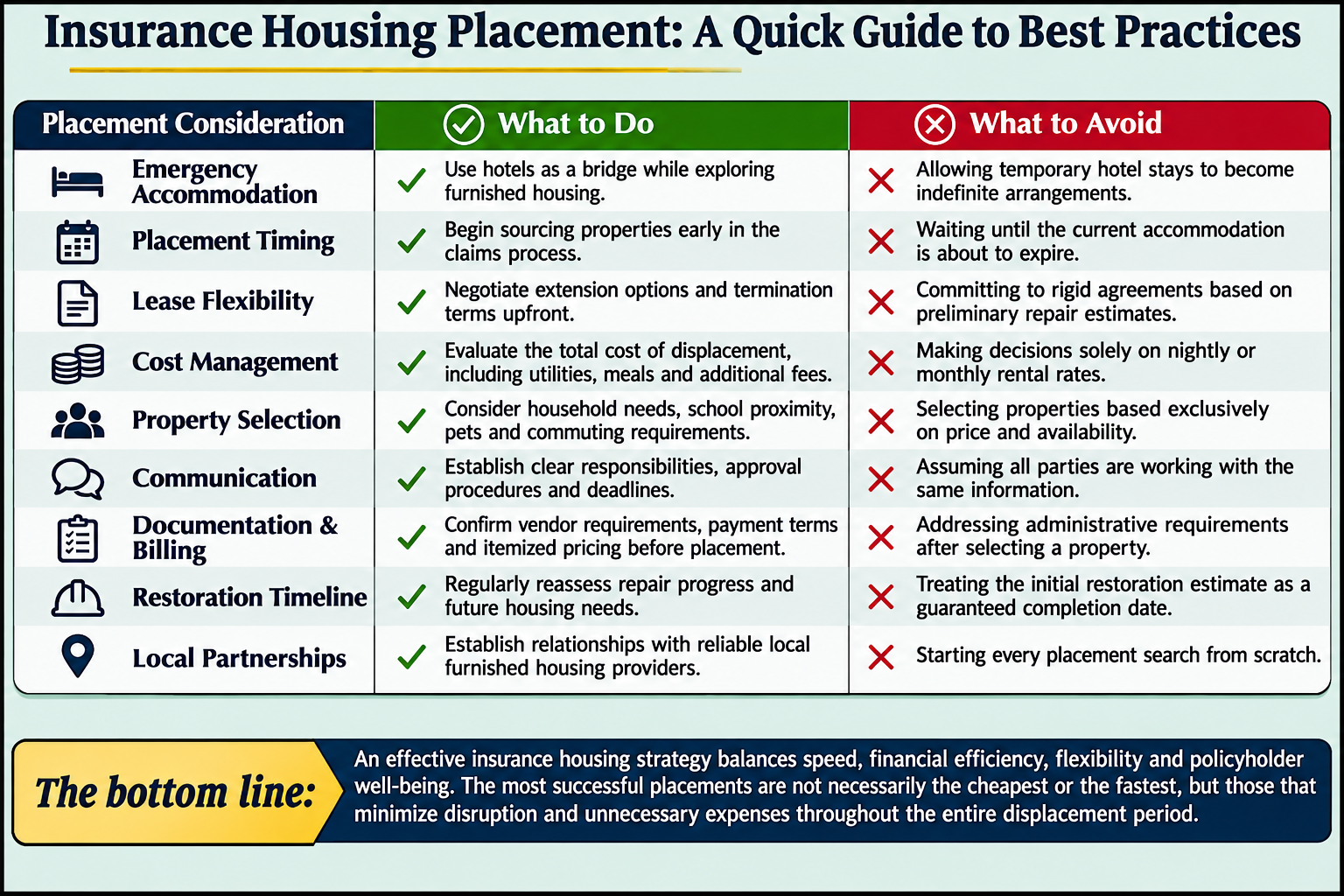
While not every delay is preventable, five recurring operational mistakes can make insurance housing placements unnecessarily complicated and expensive.
Treating Hotels as a Long-Term Housing Strategy
Hotels serve an important purpose in the immediate aftermath of a residential disaster. They offer relatively quick access to accommodation, require minimal preparation, and provide families with a place to stay while the initial damage assessment takes place.
The problem arises when an emergency solution gradually becomes a long-term arrangement.
A family expecting to spend several nights in a hotel may find itself there for several weeks as contractors assess damage, insurance approvals are processed, and restoration schedules are established. During that time, nightly accommodation charges accumulate alongside potentially reimbursable expenses associated with meals, laundry, parking, and pet accommodations.
For larger families requiring multiple hotel rooms, the financial implications can be even more significant.
There is also a human cost. Living in a hotel without a full kitchen, dedicated workspace or separate bedrooms can disrupt family routines and create additional stress during an already difficult period.
Insurance housing coordinators should begin exploring fully furnished residential alternatives as soon as there is a reasonable indication that displacement will extend beyond a brief emergency stay. Starting the search early does not necessarily mean committing to a property immediately. Rather, it creates options before the situation becomes urgent.
The objective is not to eliminate hotels from the placement process, but to use them for what they do best: bridging the gap between an emergency and a more sustainable housing solution.
Underestimating the Uncertainty of Home Restoration
One of the most difficult aspects of insurance-related housing is determining how long a family will actually need accommodation.
A restoration project initially estimated at 30 days can extend to 60 or 90 days. Hidden structural damage, contractor availability, permitting requirements, material shortages and additional insurance approvals can all alter the original schedule.
Yet temporary housing agreements are often negotiated around that initial estimate.
When a property cannot accommodate an extension, housing placement companies may find themselves searching for another residence, negotiating new terms and coordinating a second move for the same family. Conversely, committing to an unnecessarily long lease without appropriate flexibility can leave the responsible party paying for accommodation that is no longer needed.
Neither outcome is particularly attractive.
Housing providers that understand the insurance industry recognize that flexibility is not simply a convenience. It is an important component of managing financial and operational risk.
Before confirming a placement, coordinators should understand the property’s extension policies, notice requirements, early termination provisions, and potential rate adjustments. These terms should be discussed before the family moves in, rather than when the restoration project is already running behind schedule.
The lowest monthly rental rate is not necessarily the most economical option when the total cost of an uncertain placement is taken into consideration.
Prioritizing Property Availability Over Suitability
Under pressure to secure accommodation quickly, housing coordinators may focus primarily on two criteria: availability and price.
Both are important, but neither guarantees a successful placement.
Consider a family displaced from its home in North Raleigh. A furnished property in another part of the Triangle may meet the approved budget and bedroom requirements, yet introduce a significantly longer school commute, complicate childcare arrangements or make daily travel to work considerably more difficult.
A property that looks suitable on paper may prove impractical once the family moves in.
Other considerations, such as pet accommodations, accessibility, parking, reliable internet, kitchen equipment and dedicated workspaces, can be equally consequential. These are not necessarily luxury requirements. For families facing weeks or months away from home, they are often essential elements of everyday life.
A poorly matched property can generate additional communication, accommodation requests, and, in some cases, another relocation.
Effective insurance housing placement requires understanding how a household functions, not simply how many people it contains.
Gathering detailed information at the beginning of the search may require additional effort, but it can reduce complications throughout the remainder of the placement.
Allowing Communication Gaps to Complicate the Process
An insurance housing placement rarely involves just two parties.
The insurance carrier, claims adjuster, housing placement company, local housing provider, property owner, restoration contractor, and displaced household may all have a role in the process.
Each operates with different priorities, responsibilities, and timelines.
A property owner may be waiting for confirmation of a reservation. A housing coordinator may be waiting for budget approval. The insurance adjuster may be waiting for an updated restoration estimate, while the policyholder assumes accommodation has already been secured.
Without clear communication, relatively minor administrative delays can become significant operational problems.
This is particularly important in competitive furnished rental markets, where an available property may receive inquiries from multiple prospective occupants. A delay in confirming a reservation can result in losing an otherwise suitable housing option.
Establishing clear expectations regarding response times, approval procedures, reservation deadlines, and payment responsibilities can help prevent these situations.
Working with a responsive local housing partner can also simplify the process. Rather than coordinating independently with multiple property owners, national placement companies can benefit from a local point of contact who understands the market and can communicate property requirements and availability efficiently.
In insurance housing, responsiveness is part of the service itself.
Addressing Documentation and Billing Requirements Too Late
Finding a suitable property is only one part of completing a successful placement.
Insurance-related housing arrangements can involve vendor onboarding, tax documentation, rental agreements, payment authorizations, invoicing requirements, and detailed records of accommodation expenses.
Independent property owners and conventional vacation rental operators may not be familiar with these processes. While they may offer an excellent property, their administrative procedures may not align with the requirements of insurance housing placement companies.
Discovering these limitations after a property has been selected can delay move-in dates and create unnecessary work for everyone involved.
Housing coordinators should establish documentation and billing expectations early in the relationship with a housing provider. This includes identifying the contracting party, confirming payment schedules, clarifying included utilities and services, and establishing procedures for extensions and additional charges.
Transparent pricing is particularly important. Cleaning fees, pet fees, utility allowances, and other charges should be clearly communicated before a placement is finalized.
A property with a competitive advertised rental rate may become less attractive once additional expenses are incorporated into the total accommodation cost.
Administrative readiness should therefore be considered alongside property quality, location and pricing when evaluating a potential housing partner.
The Financial Impact of an Inefficient Placement
The cumulative cost of these mistakes can be substantial.
Consider a hypothetical family requiring 60 days of temporary accommodation. If the household needs two hotel rooms at $140 per room per night, the accommodation expense alone would reach $16,800 before taxes and other expenses.
A suitable fully furnished home renting for $4,500 per month would cost $9,000 over the same period, assuming comparable availability and no additional charges.
That represents a potential difference of $7,800 in accommodation expenses alone.
These figures are illustrative rather than market averages, and actual savings depend on location, availability, household requirements, applicable taxes, and rental terms. Nevertheless, the example demonstrates why housing decisions deserve attention early in the claims process.
The financial impact also extends beyond rental expenses. Repeated property searches, additional moves, administrative work, and policyholder escalations consume resources that are more difficult to quantify but remain relevant to the overall efficiency of a claim.
The goal should be to minimize the total cost of displacement, rather than simply securing the lowest available nightly or monthly rate.
Why Local Housing Partnerships Matter
National insurance housing placement companies manage assignments across numerous markets. Their geographic reach is an advantage, but maintaining detailed knowledge of every local rental market is a considerable challenge.
The North Carolina Triangle is a particularly good example.
Raleigh, Durham, Cary, Apex, Morrisville, Wake Forest and Chapel Hill are geographically connected, yet each presents different housing options, commuting patterns and rental market conditions.
Understanding these differences can be critical when accommodating a family that needs to remain close to its original home, workplace, school, or healthcare provider.
A knowledgeable local housing partner can help national placement companies navigate these considerations, identify suitable accommodation and evaluate alternatives when initial options are unavailable.
Rather than beginning every new assignment with an independent property search, establishing reliable local relationships can create a more consistent and efficient placement process.
Partnering With NC Triangle Connection
At NC Triangle Connection, we focus on fully furnished short- and mid-term housing throughout North Carolina’s Triangle region.
We understand that insurance-related placements differ from traditional vacation rentals. Families are not traveling for leisure. They are navigating unexpected circumstances, often without a definitive timeline for returning home.
Our approach focuses on matching displaced households with practical residential accommodation, taking into consideration location, household requirements, budget and anticipated length of stay.
We welcome opportunities to collaborate with national insurance housing placement companies, ALE accommodation specialists, claims professionals and relocation coordinators seeking a local housing resource in the Raleigh-Durham market.
Whether an assignment involves a single household requiring temporary accommodation or an ongoing need for furnished housing across the Triangle, establishing the right local partnership can help reduce unnecessary complications and improve the placement experience.
Looking for a local temporary housing partner in North Carolina's Triangle region?
Contact NC Triangle Connection to discuss your placement requirements and explore opportunities for an ongoing partnership.